|
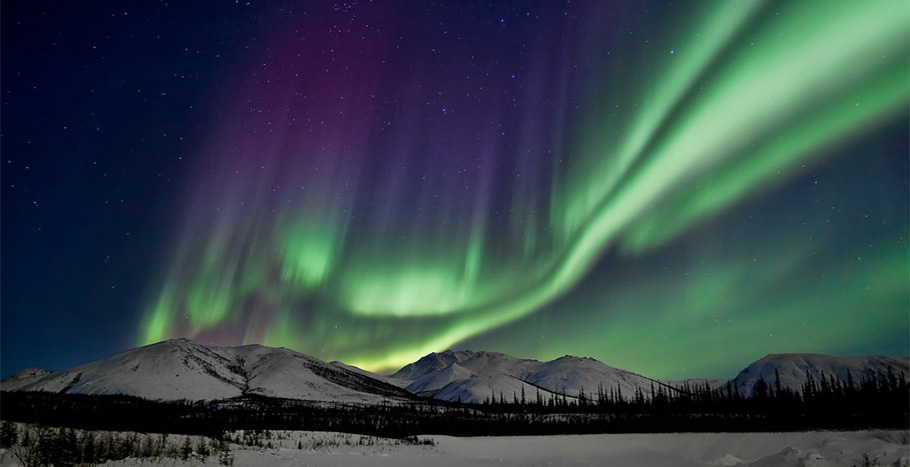
Aurora viewing at Chena Hot Springs Resort is one of the most unforgettable experiences in Alaska. Just outside Fairbanks and located directly beneath the Auroral Oval, this area offers some of the most reliable and spectacular Northern Lights displays in the world. Visitors can watch the magical Aurora Borealis from a heated viewing cabin in the hills above the resort, far away from any city light pollution, with a breathtaking 360-degree panoramic view. The Northern Lights often dance across the sky in vivid shades of green, purple, and red, creating a natural spectacle that stays with you forever. During the day, guests can explore the many winter activities available at Chena Hot Springs Resort, including visiting a sled dog kennel and enjoying a dog sledding tour, relaxing in the natural outdoor hot springs, joining a guided snowmobile tour, or trying cross-country skiing, snowshoeing, or ice skating. A special highlight is a visit to the Chena Aurora Ice Museum, a stunning attraction made entirely of ice. Winter clothing is available for rent at the resort, ensuring that visitors stay warm and comfortable while enjoying every moment of this true Alaskan adventure. Whether for excitement, relaxation, or the once-in-a-lifetime chance to see the Northern Lights, Chena Hot Springs Resort is one of the best destinations in Alaska for experiencing the Aurora in all its glory. |
Chena Hot Springs Resort Aurora Viewing Tour (NL#03)
Tour Itinerary
Dates | Rates
Options | Extensions
Aurora Borealis FAQ
|
Day
01 |
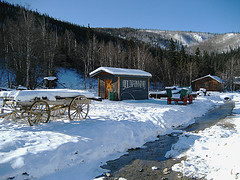 |
Fairbanks (Aurora Viewing Tour) Arrive in Fairbanks. Complimentary transfer to your hotel near the banks of the Chena River. Fairbanks is the largest city in the interior region of Alaska - just 180 miles south of the Arctic Circle. We have included this evening your first aurora viewing tour. Evening transfer to a prime aurora viewing lodge, located in the hills about 20 miles north of Fairbanks – far away from any city lights. Enjoy spectacular 270-degree aurora displays through large picture windows from the comfort of the lodge or outside. Fairbanks is synonymous with winter from late August through April with some of the best Northern Lights viewing in the world made possible by the right weather and clear skies. The location offers a great balance of occurrence, frequency and activity. Beautiful and mysterious curtains, the colors range from green to red to purple, with the brightest and most common color, a yellow-green. Return to your hotel around 3:00 am. |
|
Day
02 |
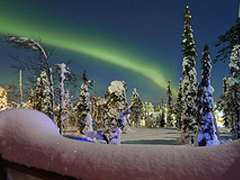 |
Fairbanks - Chena Hot Springs Resort Enjoy your breakfast at your hotel. Early afternoon transfer to Chena Hot Springs Resort - a prime Northern Lights viewing area in the hills about 60 road miles northeast of Fairbanks. The 440-acre resort is also known for its healthy outdoor opportunities in the pristine wilderness of Alaska´s great Interior - first discovered by gold prospectors at the turn of the century. In 1912 - the 40 sq mile geothermal area was the premier place to soak - for residents of the booming town Fairbanks. This afternoon, go on a guided tour of the famous Aurora Ice Museum with a beautiful display of ice art that includes sculptures, chandeliers, and a bar hand carved of ice (included). Tonight join the spectacular snow coach tour to see the aurora up close (included). From the resort you travel 30 minutes to the top of a ridge (2600 ft) where no city lights interfere the aurora. After arriving on top you can step inside the heated Mongolian Yurt to warm up and enjoy a hot beverage. For the next few hours you can always step outside and enjoy spectacular 360-degree Aurora displays. Return to the resort between 3 am - 4 am. |
|
Day
03 |
 |
Chena Hot Springs Resort Relax in the large heated mineral indoor pool, the outdoor rock lake and in numerous hot tubs – which are providing a great opportunity to soak or swim until the Northern Lights are appearing in the evening again. This afternoon join a dog sledding tour with an experienced musher (included). Dog sleds are a part of Alaskan history and there is no other sport more unique to Alaska than dog mushing! This is an enthralling opportunity to speed through our Nature trail and be pulled by some of Alaska's strongest creatures. Our friendly, experienced guides take you gliding along our serene 1.5 mile trail, in one of our locally hand built traditional freight sleds which holds up to four guests. After the ride, you’ll have a chance to take a photo with these amazing dogs. Have dinner at the rustic log lodge restaurant and then take a short walk to a heated cabin for another night of outstanding Northern Lights viewing opportunities. |
|
Day
04 |
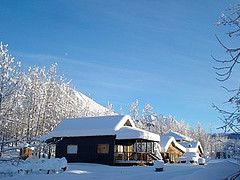 |
Chena Hot Springs Resort - Fairbanks After breakfast, you will have time to enjoy the facilities at Chena Hot Springs Resort or try winter activities such as snowmobiling, ice fishing or skating. Individual transfer to Fairbanks airport or downtown. If time permits, explore the city and check out the winter activities surrounding the All American Championship Sled Dog Race, Ice Carving Sculpture Championship or visit the famous Alaska University Museum with the States largest collection of gold, gold mining history and Alaskan heritage. The Geophysical Institute is recognized as the best in the world for Aurora research. Flight reservations to your home destination should be arranged preferably after 10:00 am. |
| Rates in US $ / per Person | Single | Double | Triple | Quad | Child | |
| August 21 - September 15 | $1431.00 | $1013.00 | $898.00 | $840.00 | $540.00 | |
|
|
||||||
| September 16 - April 21 | $1283.00 | $939.00 | $848.00 | $803.00 | $540.00 | |
First Class Hotel Category
| Rates in US $ / per Person | Single | Double | Triple | Quad | Child | |
| August 21 - September 15 | $1751.00 | $1173.00 | $1000.00 | $913.00 | $540.00 | |
|
|
||||||
| September 16 - April 21 | $1593.00 | $1094.00 | $956.00 | $887.00 | $540.00 | |
Tour Departures
|
Tour Includes
|
Flexible Tour Options – Sightseeing
| Type of Tour | Rates / Details |
| Chena Hot Springs Resort - Evening Aurora Snow Coach Tour (4 hrs) | |
| Chena Hot Springs Resort - Tour of the Sled Dog Kennel | |
| Chena Hot Springs Resort - Guided Snowmobile Tour | |
| Chena Hot Springs Resort - Ice Fishing (1/2 day or full day) | |
| Fairbanks City Sightseeing Tour |
▶ Northern Lights Viewing in Alaska | Canada – New Moon Dates
Ideal viewing time is approximately from 7 days prior to New Moon and until 7 days after New Moon. While some people may be concerned that a full moon is a problem, only weak aurora may be obstructed by the light of the moon, but in Alaska the aurora is frequently strong enough that aurora viewing is still possible on a moonlit night. As far as aurora photography goes, the aurora above a moonlit landscape actually tends to have a pleasing effect. On the whole, when participating in an aurora tour, one doesn’t need to be worried about the moon.The moon does not influence the aurora activity, the sky is just darker. You can therefore travel any time of the month.
Aurora Photography:
When you do your research for shooting the aurora, you’ll find pluses and minuses for going when a full moon is present. On the minus side is if the lights that night are somewhat faint, the brightness of the moon’s reflection of the sun can fade them out. On the other hand, a full moon can be used to illuminate objects in the foreground. Many aurora shots include buildings with lights on inside to provide an interesting foreground subject. Depending on your shooting location, this feature might not be available. However, a full moon will help light up anything you have in front of you, no matter where you are. Because shots are done for at least six to eight seconds and up to fifteen seconds or more (depending on your shutter and ISO settings), the full moon will do a great job of making what would otherwise be a silhouette into a well-lit subject. Conversely, if you choose to go when there isn’t a full moon, a strong flash can be helpful in popping light onto a foreground subject.
▶ Aurora Viewing | Prime Viewing Dates
Q: When is the best time of the year to see the Aurora
A: In northern regions such as Alaska, the Yukon Territory, Northern British Columbia and the Northwest Territories - the Northern Lights (Aurora Borealis) are seen from late August to mid April. Furthermore, during the autumn and spring, the weather is rather unstable and has a lower percentage of clear skies. Therefore, we have determined the best viewing seasons to be from mid-August to the end of September and from mid-November to mid-April. In This time of the year offers the best trade off between mild weather and dark skies. During the summer months, night skies are not dark enough to view the Aurora Borealis and in midwinter temperatures in the – 40 degree range make outdoor aurora viewing somewhat unpleasant. In other locations farther from the average aurora oval, the main consideration is the level of geomagnetic activity, which varies rather unpredictably through the year.
Q: When is the best time of the day
A: Within the most active regions of Alaska and prime viewing areas the Aurora oval typically becomes visible around local midnight. Note: this is an astronomical midnight - which may be an hour or two different from the civil or the “ wall clock “ midnight due to daylight savings time and/or peculiarities in your time zone. Spectacular Aurora displays due to geomagnetic disturbance may be seen at any time when the sky is dark, but they are relatively unpredictable. Under average conditions, observations around local midnight are most likely to yield results.
Q: What are the Temperatures in the Northern Regions
A: The average daily temperatures in February/March are approximately +20/-30 - equivalent to –8/-33 degrees Celsius.
Q: How to observe the Aurora
A: If you follow our recommendations you should be able to enjoy some pleasant Aurora viewing.
- A: Ensure - that you be there when the action begins. Because more often than not, the show picks up very quickly and also fades out as quickly as it started! Most of the auroras are out only about 2 to max 10 minutes at ones.
- A: Be Patient - this is maybe the most important thing in aurora viewing. If the show starts, it's always worth. Seeing a full-blown aurora show is just an indescribable experience.
- A: Experience - this is maybe the second most important (human) factor in aurora viewing. If you are first patient and then successful in seeing auroras, the direct consequence is that you will gain of course - experience. After a while you will begin to recognize what the aurora is doing, in which phase it is and so on. And the most important thing - You will learn how a weak aurora looks like!!! Because, even that we are hoping to see a bright "eruption phase " aurora, the aurora isn't all the time bright. So the experience will help you to see and determine if there is a weak aurora, which could get brighter in the future! I
- A: Light Conditions - the primary reason for not seeing an aurora are any city light obstruction or a bright twilight. Our destinations are far away from a city or other light obstruction and therefore should guarantee the best viewing conditions possible.
- A: Weather - don't think overcast weather prevent you from Aurora viewing. Although often clouds do ruin everything, but at times...you can also get lucky breaks! Another example, during a major aurora storm in 2001 the forecasts and satellite pictures showed that it should be overcast, but it was not. We could see the stars and the aurora through the thin clouds! So, give it a try anyway...it could be worth it!
Q: What causes the Aurora
A: Energetic charged particles from the magnetosphere. These particles are electrons and protons that are energized in the near geo-space environment. This energization process draws its energy from the interaction of the Earth's magnetosphere with the solar wind. The magnetosphere is a volume of space that surrounds the Earth. We have this magnetosphere because of Earth's internal magnetic field. This field extends to space until it is balanced by the solar wind.
Q: What is the altitude of the Aurora Borealis
A: The bottom edge is typically at 100 km (about 60 miles) altitude. The aurora extends over a very large altitude range. The altitude where the emission comes from depends on the energy of the energetic electrons that make the aurora. The more energy the bigger the punch, and the deeper the electron get into the atmosphere. Very intense aurora from high-energy electrons can be as low as 80 km (50 miles). The top of the visible aurora peters out at about 2-300 km (120-200 miles), sometimes high altitude aurora can be seen as high as 600 km (350 miles). This is about the altitude at which the space shuttle usually flies.
▶ Sun | Solar Wind | Magnetosphere
The solar wind is the outermost atmosphere of our sun. The sun is so hot that it boils off its outer layers, and the result is a constant outward expanding very thin gas. This solar wind consists not of atoms and molecules but of protons and electrons (this is called a plasma). Embedded in this solar wind is the magnetic field of the sun. The density is so low that we may well call it a vacuum. However tenuous it is, when this solar wind encounters a planet, it has to flow around it. When this planet has a magnetic field, the solar wind sees this magnetic field as an obstacle, as protons and electrons cannot move freely across a magnetic field. These charged particles are constrained to move almost always only along the magnetic field. Likewise, when they are forced to move in a specific direction, a magnetic field will move with them or will be bent into the direction of the flow. Whether the magnetic field forces the plasma motion or whether the plasma motion bends the magnetic field depends on the strength of the field and the force of the motion. When the solar wind encounters Earth's magnetic field, it will thus bend the field unless the field gets too strong. The strength of the magnetic field falls off with distance from Earth. The distance at which the solar wind and the magnetic field of the Earth balance each other is about 60,000 km away, or 1/10 of the distance to the moon. The inside of this volume that is bounded by the solar wind is called the magnetosphere. At the interface of the solar wind and the magnetosphere, energy can be transferred into the magnetosphere by a number of processes. Most effective is a process called reconnection. When the magnetic field in the solar wind and the magnetic field of the magnetosphere are anti-parallel, the fields can melt together, and the solar wind can drag the magnetospheres field and plasma along. This is very efficient in energizing magnetospheres plasma. Eventually, the magnetosphere responds by dumping electrons and protons into the high latitude upper atmosphere where the energy of the plasma can be dissipated. This then results in aurora. Here is an animation (1.6Mb) that illustrates this process.
▶ Alaska and Canada Northern Lights Viewing | Photo Support
Q: How do I take the best pictures
A: For the first -time or for seasoned aurora photographer, a 35 mm camera on a tripod equipped with a cable release is a must. Use a wide-angle 24 mm to 50 mm lens and set it to an f-stop which is the fastest – or one slower to avoid distortion of bright star images – usually f/1.4 – f/2.8.
- Exposures of 5 to 15 seconds work well unless the aurora is faint or mostly stationary, in which case the exposure time should be doubled. People tend to overexpose their photos, causing the aurora to look washed out. If the aurora is bright, moonlight and city lights should not interfere and can offer an interesting foreground. Never use filters because they could cause internal reflections. If it is very dark, a silhouette of a tree of lit cabin will certainly add to the scene. Video cameras are normally not sensitive enough to successfully record the aurora.
- Because aurora occurs under clear skies, photographers will often be shooting in temperatures well below zero. Since cold saps camera batteries, it is advisable to use an older camera with mechanical shutter instead of one that is fully automatic. Cold makes plastic brittle, so the cable release should be wired mesh vice plastic. At minus 40 Fahrenheit, all cameras will freeze in less than 10 minutes; before taking it inside to warm, place it in a zip-lock plastic bag to reduce condensation.
- Tape the lens to infinity so that it doesn’t slip and cause your images to be out of focus. Don’t try for a 37th exposure; it might break the film, and it is best to overexpose your first frame on the roll so that the film processor knows where to start cutting your negatives. Wind your finished roll of film slowly so that it doesn’t shatter or cause static buildup – this may appear as scratch. While Kodak film processing mailers are generally reliable, it may be worth the extra cost to have the film processed through a custom photo lab. Going the custom lab route will save the film from being lost in the mail or scratched in an automated process.
- Slower speed film (print or slide) has better gain resolution; making for a sharper image when enlarged. Thus it may be too slow to record the fine detail structure of the aurora.
- Medium-speed color film (200 /400 ASA) works as well. Purists insist on slide film. You can try a faster film, but keep in mind that graininess and color quality tend to decrease with increasing film speed. We recommend using 400-speed film is a good compromise between detail and quality of the image.
- Different films will emphasize different colors of the aurora, so experimentation is advisable. Bracketing your exposures (05 seconds, 10 seconds and 15 seconds) will give you the characteristics of the film. Even in a roll of 36 exposures, there are only a few shots that are acceptable to me.
Q: Can I videotape the Aurora
A: Videotaping the aurora generally takes highly specialized video equipment. Generally – camcorders are not sensitive enough to see the aurora, though a few will record a faint, smoky image given a sufficiently bright aurora. Your best bet for video showing the color and motion of the aurora is to purchase a professionally – recorded tape such as one distributed form the Geophysical Institute in Fairbanks. Thus, some home video cameras are capable of picking up bright auroras. In particular, a camera rated at for example: less than one-lux sensitivity has captured – faintly and colorlessly a bright auroral arc. Many cameras which have special features such as digital zoom and / or vibration compensation are much less sensitive and will not show the aurora. The most annoying problem with home video cameras in low-light situations is their inability to focus. If your camera has a focus-lock button, you may be able to focus on a distant, brightly-lit object, and lock the focus then see if you can pick up the moon or perhaps catch a hint of an extremely bright aurora. Just don’t expect much, because home video cameras aren’t designed to do low-light recording.
Q: Do you have any Aurora Photography Tips
A: When you do your research for shooting the aurora, you’ll find pluses and minuses for going when a full moon is present. On the minus side is if the lights that night are somewhat faint, the brightness of the moon’s reflection of the sun can fade them out. On the other hand, a full moon can be used to illuminate objects in the foreground. Many aurora shots include buildings with lights on inside to provide an interesting foreground subject. Depending on your shooting location, this feature might not be available. However, a full moon will help light up anything you have in front of you, no matter where you are. Because shots are done for at least six to eight seconds and up to fifteen seconds or more (depending on your shutter and ISO settings), the full moon will do a great job of making what would otherwise be a silhouette into a well-lit subject. Conversely, if you choose to go when there isn’t a full moon, a strong flash can be helpful in popping light onto a foreground subject.
▶ More about Northern Lights Tour Packages
Q: Flights to Alaska
A: Alaska -, Continental -, United -, Delta Airlines and US Airways are providing multiple flight connections daily to Anchorage and Fairbanks from the lower 48's. For current rates please refer to: >> Alaska Airlines or other airlines and any ticket reservation systems of your choice. Sorry, but we do not provide a reservation service for airlines tickets. Accordingly our advertised tour rates do not include any flights to/from Alaska.
Q: Recommended Clothing
A: We recommend fleece or heavy wool sweaters, down jackets or similar cold weather gear with attached hood, gloves, sun glasses, swimsuit, wool shirts, cotton or thermal underwear, mittens, sturdy winter boots, lip balsam, moisturizing cream. Winter gear and clothing may be rented at your local outdoor stores or at REI - Recreational Equipment INC - in Anchorage (please contact the stores directly)
Q: Meals
A: Meals are not included in our tours (except as otherwise stated within each "Tour Included" section) The cities of Fairbanks and Anchorage are providing a large number of restaurants in all categories. Our lodges and resorts are providing a dining room or a full service restaurant with a extended food and drink selection.
Q: Sightseeing Tours
A: Sightseeing tours are not included in our tour packages (except as otherwise stated within each "Tour Included" section) Thus, we do offer a variety of optional tours. Please contact us or simply check our websites.
Q: How far in advance should I make a Reservation
A: This is hard to predict but if you travel during: (1) New Moon Dates (2) Public Holidays (3) Long Weekends (4) Alaska Events etc. tours are most likely sold out and it will be virtually impossible to materialize a last minute request. Accordingly it is highly advisable to book as early as possible.
▶ Chena Hot Springs Resort | Accommodation Description
Moose Lodge Room / First Class Category
The Moose Lodge features 40 spacious rooms with two queen beds that have comfortable 14 inch mattresses.
Each room includes a full bath, 8 channel TV, hair dryer, coffee maker, telephone and unlimited swim/soak passes during your stay.
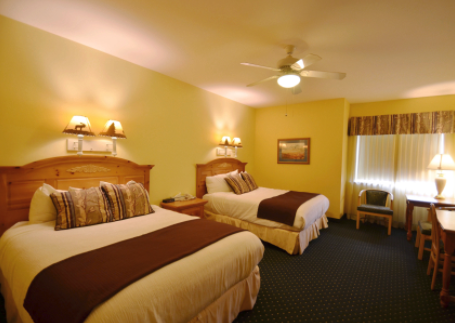
Fox Room / Superior Category
The Resort features 32 Fox Rooms, each with a unique Alaskan Decor and close proximity to the hot springs.
A comfortable option, smaller and more intimate than the Moose Lodge yet cozier, each room has two double beds,
a 3/4 bath with shower, 8 channel TV, hair dryer, coffee maker and unlimited swim/soak passes during your stay. No room-in telephone.